
European football needs a sectoral pathway
Long read: Why it is essential, what it would address, and who should lead it

The previous post here reported that UEFA had removed its 2040 net-zero target from its updated sustainability strategy text. The story was picked up by Business Green and Edie, and UEFA responded publicly to both. My thoughts on their response are in a LinkedIn post.
All of this left a bigger question open - one touched on in other posts here:
What would a credible decarbonisation pathway for European football actually look like - who develops it, on what evidence, and who takes responsibility for it? UEFA’s repositioning from collaborative net-zero leader to advocate makes the question more urgent, not less.
This piece doesn’t attempt to develop that pathway. It makes the case that one needs to exist, examines what it would have to grapple with, and asks - openly - who should develop it.
1. What a sectoral pathway is, and what it isn’t
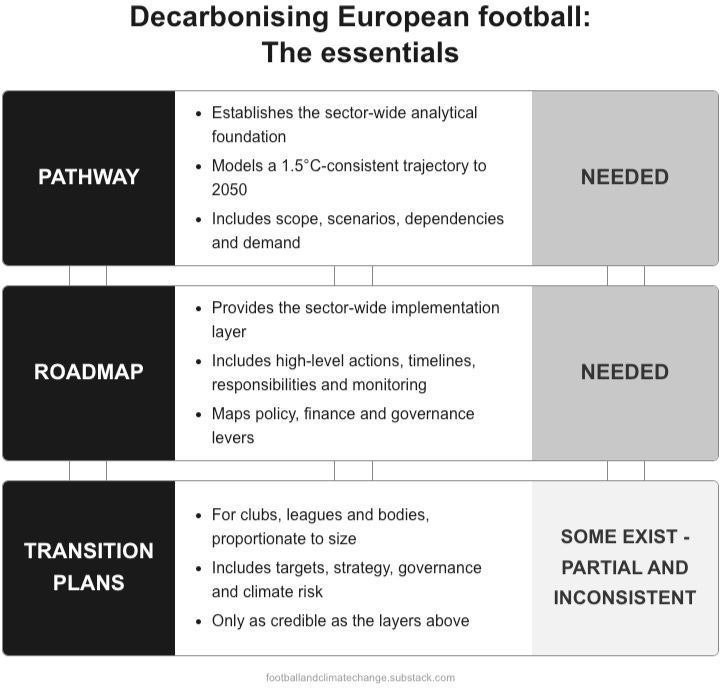
You may have come across the words “pathway” and “roadmap” used in different contexts in climate discourse - and often interchangeably. It’s worth being precise about the distinction.
Put simply, a sectoral decarbonisation pathway is an analytical foundation. It maps where a sector needs to get to, in line with limiting global warming to 1.5°C, the central goal of the Paris Agreement, and what the terrain looks like: the timelines, conditions, dependencies and constraints. It is not a plan, a strategy, or a commitment. It is the evidence base that makes credible plans possible.
Built on top of a pathway sits a roadmap: the implementation layer that translates analytical findings into high-level sector-wide actions, timelines and responsibilities. In practice, the two are often developed as a package rather than in strict sequence, with the labels frequently conflated even where the underlying concepts are distinct. This piece focuses on the pathway, though there is a strong case for the two to be developed together. The roadmap deserves its own detailed treatment - this piece sets that aside deliberately, but it is the necessary next question once the pathway case is made.
Individual organisations then develop their own “transition plans”1, the organisation-level commitments, targets and strategies required under recognised frameworks, grounded in what the sector-level analysis says is necessary.
Football currently lacks all three layers. While some clubs and bodies are developing transition plans, the numbers are small and approaches inconsistent. And critically, without either pathway or roadmap beneath them, those commitments - however well-intentioned - are developed without an external reference point that would make them collectively meaningful. Without a pathway, roadmaps are built on sand, and there is no way to ensure individual transition plans are either sufficient or effective at sector level.
It is worth being clear about where UEFA’s documents sit in this hierarchy. Its Sustainability Strategy and its Carbon Reduction Plan, which together represent UEFA’s most substantive climate commitments, both sit at the third tier, the level at which genuine transition plans should operate. But neither meets the standards set by recognised external frameworks2. The sustainability strategy sets direction without the analytical foundation to make it credible, and the Carbon Reduction Plan lists operational measures without the milestones, governance or scenario analysis that a transition plan requires. UEFA has some of the architecture of the third tier. It does not yet have its substance.
Other sectors have done this work - with instructive results. The World Resources Institute’s apparel roadmap and the World Travel and Tourism Council’s net-zero roadmap offer some methodological parallels: consumer-facing, multi-actor sectors with fragmented governance, where the pathway and roadmap work created both a shared analytical foundation and an accountability infrastructure. Neither is a perfect template - the approaches are not lift-and-shift methodologies, and neither sector is on track for 1.5°C. But in apparel, for instance, the number of companies with approved science-based targets has grown from a dozen in 2019 to over 600 today, and the annual progress tracking means the gap between ambition and delivery is visible, attributable, and contested. That is what accountability looks like. Football is not near that stage.
2. Why other sectors have pathways and football doesn’t
The sectors that have done this work share some common features. They are large enough to matter to investors and policymakers. Their emissions are distributed across many actors rather than concentrated in a few producers. And they face genuine governance complexity: no single body can simply mandate a solution.
That description fits apparel, tourism, food and retail, and events. These are not easy sectors to decarbonise. But they have made the analytical investment.
Football has not - and nor, it should be said, have most other sports. Football is economically significant, of unparalleled cultural importance, and governed through a layered web of clubs, leagues, national associations and international bodies where no single actor controls the whole. If anything, that complexity makes the analytical foundation more important, not less.
Relatedly, UEFA provides a common carbon accounting tool which, as adoption grows, could contribute to the evidence base a pathway would need. But the calculator is voluntary and focused on organisations competing at European level. Its guidance on fan travel - the largest source for most clubs and events - explicitly allows spectator travel emissions to be excluded from reported metrics and targets entirely. It also references the Paris Agreement as motivation, but does not define what a 1.5°C-consistent outcome for the sector would look like. Each actor can claim progress while the aggregate picture remains unmapped.
At the same time, there is a growing body of baselining work - the Wilby meta-analysis, the WEF/Oliver Wyman Sports for People and Planet report’s estimate of 400-450 million tonnes of CO₂e annually for sport as a whole, and others - though gaps remain. Alongside this, specific emissions hotspots, such as fan travel, embodied emissions and merchandise, are increasingly well understood. What does not yet exist is the next analytical step.
A full understanding of why football has not taken this step is beyond the scope of this piece, but part of the answer lies in governance. Football’s governing structures have been characterised in European Commission and UK Government analysis as layered, with often competing authorities, misaligned incentives, and a long record of failed self-regulation. This makes collective analytical investment structurally difficult. No single body has both the authority and the incentive to commission work that maps what the sector needs to do. That shift in UEFA’s position - from collaborative net-zero leader to advocate for voluntary action - is less a cause of that gap than a symptom of those deeper structural issues.
3. What makes football’s analytical challenge distinctive
Even setting aside governance, building a pathway for European football involves a particular set of analytical challenges - some shared with comparable sectors, others more specific to how football operates. This piece does not attempt to catalogue them all; that is work for the pathway itself. But three are worth examining here.
The most significant is dependency. Fan travel is football’s largest source of emissions for many clubs and events. Facility energy is a significant source too, though the picture beyond that is less clear - stadium construction and refurbishment, merchandise, and capital goods all compete for relevance depending on which emissions reporting boundary is chosen. What many of these sources share is that they depend heavily on decarbonisation happening elsewhere: in the wider transport system, in the electricity grid, in supply chains football does not control.
A football pathway cannot simply assume those transitions happen on schedule. It has to engage with them. For example, on aviation, the challenge is not just timing but credibility. The main European aviation industry roadmaps, such as Destination 2050, rely heavily on sustainable aviation fuel scaling at a pace and cost that some respected independent analysts consider optimistic, and treat continued passenger demand growth as essentially given. More analytically rigorous frameworks are more transparent about uncertainty - including analysing demand management as a lever. On road transport, even if EV adoption proceeds as projected, it does not translate automatically into sufficient reductions in emissions from fan travel - electric cars still fill car parks, shifting mode share is a further dependency too.
This is the pathway of pathways problem: a credible football pathway is partly an exercise in understanding how football sits within, and depends upon, other sectors’ decarbonisation trajectories - and what happens when those trajectories fall short.
A second challenge is scope. What emissions does a pathway for European football actually cover? For example, fan travel is the largest source for many clubs and events, yet the dominant accounting framework - UEFA’s Carbon Footprint Calculator - explicitly recommends that spectator travel emissions be reported ‘separately, if at all, and not added together with other Scope 3 categories.’ This has provided the basis for some clubs and bodies to exclude fan travel from their targets. A pathway analysis would need to look rigorously, expertly and independently at what boundaries should be set - and to justify that position transparently.
This matters because rigorous climate accounting has a clear hierarchy: organisations should reduce emissions across all scopes as far as possible - including addressing the difficult decisions - before addressing residual emissions: those that remain after all practical reductions have been made. Those decisions, on fan travel, competition format, calendar design, are precisely what a pathway needs to interrogate first, and what a roadmap built on top of it would then need to translate into action. Resolving the scope question is therefore not a technical preliminary; it is part of the pathway’s core analytical purpose. A pathway has to take a position. Leaving things open replicates current issues rather than solving them.
A third dimension is easy to understate. Football is watched, followed and loved by billions of people. The choices it makes, about where matches are played, how fans travel, which sponsors it accepts, are visible in ways that most sectors’ choices are not. When football makes choices such as flying to overseas pre-season tours, expanding already demanding competition schedules, or hosting finals in locations that require long travel distances, it normalises those choices at scale. When it does the opposite, the signal travels further than the direct emissions saving. That cuts both ways for a pathway: it is an argument for taking the work seriously, and a reason the pathway needs to be analytically credible rather than merely presentable.
4. What a football pathway would need to address
With those challenges in view, what would a pathway actually need to do?
A pathway for European football would not start from scratch. There is now a sufficient body of baselining work - on emissions sources, hotspots, and sector comparisons - to review and build on. What it would need to do is take that foundation further in directions that existing work has not.
It would need to model alternative futures, not just describe the present: what do European football’s emissions look like in 2030 and 2040 under different assumptions on issues such as competition formats, the number of games played, travel patterns and venue energy, among others? What does a 1.5°C-consistent trajectory actually require the sector to do, and by when?
It would need to stress-test decarbonisation scenarios in sectors such as transport, aviation and energy, rather than assuming them as given - football cannot build its pathway on the assumption that hard-to-decarbonise sectors will simply stay on track - or that their decarbonisation will automatically resolve football’s.
It would need to address the demand-side questions that current football climate strategies fail to address - such as what competition format means for emissions, and what the implications of changing the number of games may be. These are not peripheral - they may be among the most consequential climate decisions football makes3. A sector pathway that tries to detour around its hardest terrain is not a roadmap to net zero - it is a road to nowhere.
It would need to establish a sector-wide emissions baseline that takes a clear and defensible position on scope - being explicit, for instance, on how fan travel emissions are treated rather than leaving that to the discretion of individual organisations.
It would need to engage with how the challenge is distributed across the pyramid. The emissions profile of a Champions League club is very different from a lower-league or grassroots club. Women’s football is growing rapidly and represents a planning opportunity that a pathway built only around the elite men’s game would miss. Any serious analytical exercise needs to address the full pyramid, and to ask honestly who bears the costs of transition and whether that is fair. It would also create a shared basis for understanding which actions are delivering genuine emissions impact - and which are not.
And it would need to grapple with a football-specific governance dependency that sits alongside the transport and energy dependencies discussed in the previous section: the relationship with FIFA4. European clubs and national teams operate within a calendar and ruleset that UEFA does not fully control. FIFA sets the international match calendar, determines World Cup formats and host nations, and runs the expanded Club World Cup. A European pathway that models competition format and calendar emissions cannot treat these as purely UEFA decisions - some significant emission-related decisions in European football cannot be addressed without FIFA’s involvement.
It must therefore also be explicit about where the limits of European governance lie, and what that means for the ambition and scope of the work.
A pathway cannot resolve the key debates. Nor does this list exhaust the terrain it would need to cover. But it needs to confront the hard questions honestly rather than design them out.
5. Who should develop it
If the case for a European football sector pathway is accepted, the next question is who should develop it. There are at least three broad options, each with different implications for credibility, feasibility and speed.
The strongest option, institutionally, would be a joint commission involving the European Union and UEFA, with independent analytical support. The EU has established precedent for this kind of work: its Transition Pathways process has produced co-created, multi-stakeholder decarbonisation frameworks across more than a dozen sectors, with Commission officials and sector bodies co-chairing the analytical process.
Importantly, a 2022 voluntary cooperation agreement between the Commission and UEFA explicitly includes climate action as a shared objective - and with that agreement now being actively renewed, there is an imminent institutional moment where climate ambition could be written into the formal relationship rather than left as a voluntary aspiration. The EU Work Plan for Sport 2024-2027 and its following cycle, and the EU’s Green Sport Expert Group, provide further existing infrastructure. This option is not institutionally narrow, and it is not football marking its own homework.
The second option is a UEFA and European Club Association-led exercise. This would be faster to convene and more directly connected to the decision-makers who control competition formats, calendars and commercial relationships. But it raises a credibility flag. The ECA represents clubs whose governance structures are oriented toward short-term commercial cycles - the very conditions that make long-term analytical work on these questions difficult to commission, and harder still to act on. A process led jointly by UEFA and ECA would need to demonstrate that independence, in particular, through its governance.
The third option is a broad coalition - independent, multi-stakeholder, drawing in independent expertise (academic, environmental and civil society) alongside football governance. No single convener is named here deliberately. This piece is itself an argument for that work to happen. But the case has been made. If institutions exist with the capability, the credibility and the appetite to lead this work, the question is no longer whether it is needed - it is whether they will step forward.
Whichever route is pursued, the process would need to be designed with clear eyes about the pressures bearing on all participants - commercial, sporting, political, regulatory and reputational - engaging with them honestly in the analytical work, while remaining free to follow the evidence wherever it leads. The analytical work could encompass pathway and roadmap together - the case for developing both as a package is strong, and the precedent from comparable sectors supports it. Any process would also need to engage external stakeholders - including FIFA, whose jurisdiction over significant areas of European football means some emission-related decisions fall outside UEFA's control. Engaging FIFA would strengthen the work; the absence of that engagement would need to be explicit about what a European pathway can and cannot address.
6. Close
The argument of this piece is simple, even if the work it calls for is not. European football is a sector of significant emissions, unparalleled cultural influence, and profound governance complexity. It has targets. It has frameworks. It has many initiatives. It has a growing body of baseline analysis. What it does not have - as the framework above makes plain - is a Paris-aligned, system-wide decarbonisation pathway - the analytical foundation that would make everything else coherent.
That gap has real consequences. Without it, individual organisations develop plans and set targets against unmapped terrain, draw scope boundaries that reflect the discretion current frameworks allow, and point to progress that may not add up to anything at sector level. The gap left by UEFA's repositioning away from collaboration makes the underlying issue more visible, but it did not create it.
Building the pathway will require grappling with questions that football’s leaders have not yet fully faced: about what emissions the sector is genuinely accountable for, about the decisions that drive its largest footprints, about what a fair distribution of the transition effort looks like across the pyramid. None of that is straightforward. But other sectors - with comparable complexity, comparable governance challenges, and no fewer commercial pressures - have done it.
As set out in the opening of this piece, a pathway is the foundation - the analytical work that makes a credible roadmap possible, and credible transition plans possible after that. The two could credibly be developed together, but the pathway has to come first - and European football currently has neither. That is where the work has to begin.
The question this piece leaves open is not whether European football needs one. It does. The question is who steps forward to deliver it - and whether they do so with the independence, the analytical rigour, and the genuine climate leadership the task requires.
The Football and Climate Change Newsletter is independent, unfunded and free to read. If you find it useful, please make a contribution - it keeps the newsletter free and the analysis coming.
Fran James (he/him)
Football and Climate Change Newsletter
info@footballandclimate.org
LinkedIn | Bluesky | X
The pathway/roadmap/transition plan distinction used here reflects terminology drawn from comparable sector decarbonisation work rather than a single codified standard. The underlying conceptual distinction - analytical foundation, implementation layer, organisation-level commitment - is consistent across the principal frameworks referenced in this piece.
Key frameworks governing transition plan requirements include: CSRD (Corporate Sustainability Reporting Directive), IFRS S2 (International Financial Reporting Standards - Climate-related Disclosures), SBTi (Science Based Targets initiative) Corporate Net-Zero Standard, and TCFD (Task Force on Climate-related Financial Disclosures).
As noted in a previous post, a 2025 report by the French think tank The Shift Project, supported by the French Football Federation, the Ligue de Football Professionnel and others, concludes: “Despite our attempts, none of our scenarios reconcile climate goals with an increase in spectator numbers and/or international matches; at best, these numbers will need to stabilise.”
This piece focuses on European football, but the case for a sectoral pathway applies globally. FIFA’s record on climate governance makes meaningful action at global level unlikely in the near term. A European pathway should therefore be developed with one eye on global applicability - designed to inform and learn from equivalent work in other regions, rather than to set a template for them to follow.
Brilliant piece. I can't believe clubs are able to get away with not reporting fan travel as Scope 3. That feels like a real own goal, but I'm not that surprised; this is UEFA we're talking about.
Great piece Fran, addressing an important gap there!