
Round-up #13
Neymar, the Climate Cup, feeling the heat, and more

Hello all!
Welcome again to your friendly fortnightly round-up of developments on football and climate change. There’s a smaller set of articles than usual this time, but it’s still packed full of useful insights and perspectives. Please ‘like’ and ‘share’ the newsletter with others.
Feeling the Heat
The headline message of a new report from FIFPRO, the union for professional football players, is that:
“Heat guidelines should be adopted and respected by football stakeholders, clubs and national teams for matches and training and embedded within regulations (e.g., minimum medical requirements, laws of the games, collective bargaining agreement for national competitions; FIFA competition regulations, social dialogue).”
A key part of the statement here is the need for guidelines to be “embedded within regulations”. With higher temperatures becoming a more regular occurrence, and increasing heat risks to players, will governing bodies act to clarify and embed guidelines in their rulebooks?
As Lord Coe put it when speaking on climate change and the extreme heat that forced changes at the World Athletics Championships …
“Constituent groups like sport are going to have to figure this out for themselves, because I don’t think we can rely on governments to remotely get to grips with what is going to be a massive shift in reality in the next few years.”
Air Travel
Telegraph Sport has calculated that the teams in the Women’s World Cup were required to travel more than 70,000 miles, almost three times the circumference of the Earth. It says that despite efforts to make the tournament ‘greener’, FIFA has been accused of paying lip service to sustainability and “With Canada, Mexico and the USA staging 2026’s men’s event, the use of air travel is set to soar again.”
Separately, Stuff put questions to FIFA about its extensive use of private jets during the Women’s World Cup, and asked how it aligns with its messaging around sustainability. “But the organisation did not address those questions."
What next on FIFA’s approach to sustainability? A number of key documents are due this year including the World Cup 2022 Sustainability Report and ex-post Greenhouse Gas Accounting Report; the World Cup 2026 Sustainability Strategy; and the bidding process for the World Cup 2030. Keep your eyes peeled for those.
Elsewhere, Neymar’s flight from Paris to Riyadh, Saudi Arabia, on a private Boeing 747 was estimated to be equivalent to 85 times the environmental impact of the average person in the UK per year. It attracted a lot of criticism as documented by The Independent and led to Greenpeace calling for a ban on private jets. AviationSource News noted that “Whether this controversy serves as any sort of catalyst for change or is merely a passing episode, it underscores the urgency of addressing the environmental costs associated with extravagant travel decisions.”
"People have a universal love of football, so there’s no better industry to promote sustainability – and what we can do as football supporters to be more environmentally conscious.”
Hector Bellerin, footballer in this article on his investment in Forest Green Rovers.
Around the world
Two articles in Forbes by Vitas Carosella
This article looks at how Vasse Soccer Club in Western Australia is responding to climate change and preparing for the future. A new report by the Australian Government says there could be massive economic pain for the country if the temperature rises exceed 2°C.
1 Ladakh FC in India and the upcoming Climate Cup. The tournament will take place in the city of Leh in the Himalayas, a region seeing more intense rains linked to global warming.
And two articles from Deutschlandfunk in Germany
Sustainability and the Bundesliga. This looks at the progress that has been made over the last year and where there is room for further improvement.
On The Football for Forests initiative. This takes a look at this new project and experts views on it.
A new sustainability index for clubs in the Italian Serie A league has been announced with the findings to be presented this September.
Quotes
“Audiences now more than ever want to see what a brand (or a sporting organisation) is doing to improve the world and what impact they are having on communities and the environment. Sport, because of its reach, and because of its ability to connect emotionally with audiences, is an amazing tool to spark real change.”
Dominic Grainger, CEO, WPP Sports Practice speaking to Inside World Football
“With the global shift towards environmental consciousness, fans expect their clubs to be responsible. Failure to take concrete steps towards sustainability can lead to disillusionment and disapproval among supporters – particularly among the younger generation.”
Jack Quinney, PHA Group in Football’s journey towards Net Zero
“Sport events can act as catalysts for transformative climate resilience and sustainability transitions. They can function as intermediary advocates for climate action and decarbonising events”.
Peter Gollagher and Sebastian Fastenrath in Transformative climate resilience and sport mega-events
More generally in climate news …
A useful infographic from the Energy & Climate Intelligence Unit, which aims to help build a better understanding of different terms on climate goals
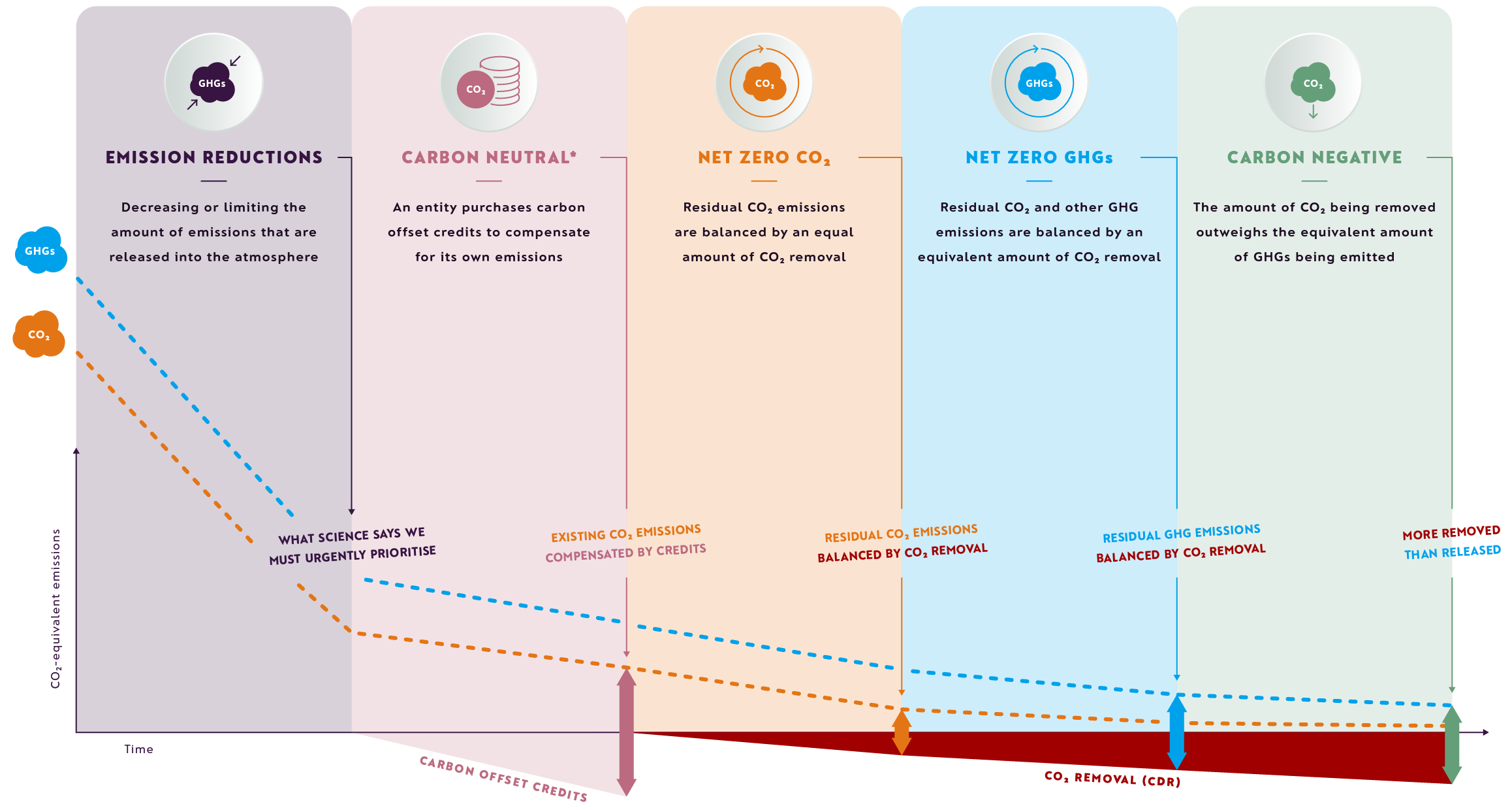
The Science-Based Targets Initiative reported a sharp rise in companies setting science-based targets in 2022. It includes companies representing more than a third of the global economy by market capitalisation (though it has yet to include any football clubs or governing bodies).
Bain and Company have recently noted companies that are “Effective Decarbonisers” capture significantly greater financial benefits and greater value from each decarbonisation initiative than “Carbon Laggards”. Separately, an article in Harvard Business Review focuses on demystifying emissions reporting.
In the UK a new Business Climate Hub for small and medium-sized businesses was launched that includes a free carbon calculator and a suite of tools and guidance which may come in helpful for clubs.
That’s yer lot. As I said above, please ‘like’ and ‘share’ the newsletter with others. And I’m up for any feedback or suggestions for guest posts and topics to cover in-depth. See you again soon …
Fran James (he/him)
Football and Climate Change Newsletter
footballandclimatechange@gmail.com
@fbandclimate