
Round-up #9
Glastonbury, UEFA, extreme weather, the Grateful Dead and much more

Because football is more than a game
Hello all,
It’s been a proper busy fortnight for news and developments. I may switch to a weekly format if this continues. I hope you find something that tickles your fancy. Diving straight in …
Clubs leading the way
An article in Forbes looks at The Oakland Roots And Soul. Many insights include their partnering with Stanford University. Are there opportunities for other clubs to collaborate with their nearby universities?
The Guardian, with Grist, covered Vermont Green FC who are “at the vanguard of a burgeoning movement”.
A lovely video from Lyon - La Duchère includes highlights from their first annual event dedicated to raising young people's awareness of ecological issues.
Eventful
The inaugural 2-day UEFA Respect Forum brought together 200 people to focus on sustainability. Players, clubs, authorities and experts took part. It was a big set-piece conference and I’ve taken a more in-depth look into it below.
A UNESCO international conference of Ministers and officials agreed to move forward with work on “a labelling system for the social and environmental legacy,
and ongoing impact, of major sports events”.
Glastonbury rocked! Footballers Katie Rood and David Wheeler, along with Football for the Future led a panel discussion at the Speakers Forum. David Wheeler also talked to the i newspaper about Glasto, football and climate change.
The European Football Fans Congress, along with the Football Supporters’ Association, held a workshop on environmental sustainability at their annual meeting.
Speakers at the Green Sports Alliance Summit included FIFA, FC Barcelona and many more. If anyone can give a read-out, please do. An official event report is due to follow.
One key takeaway from all these events? Communication and sharing of perspectives is growing. Converting this to even more action is key.
Extreme Weather
Wrexham AFC’s stadium was hit by a large leak due to torrential rain. Initially concerns about structural damage were allayed after an inspection.
Scotland vs Georgia was suspended after seven minutes due to a waterlogged pitch before resuming nearly two hours later. Video below …
What weather might we expect in the USA during the Club World Cup in 2025, and the men’s World Cup 2026? On a quick look, over the last fortnight …
In the Gold Cup, hosted in the US, lightning storms delayed three matches in Fort Lauderdale. “We need to look at this whole aspect of playing games in these conditions", said Guyana coach Wayne Dover.
Torrential rain delayed Trinidad & Tobago vs Saint Kitts & Nevis in Miami.
Guadeloupe vs Cuba kicked off in Houston in temperatures exceeding 100°F. The game took place in the Shell Energy Stadium as part of a tournament whose sponsors include TotalEnergies.
In club football, an NWSL match, NY/NJ Gotham FC vs Chicago Red Stars, was delayed due to potential lightning strikes with fans told to exit the stands and seek cover. Another Gotham FC game was cancelled on 7th June due to poor air quality.
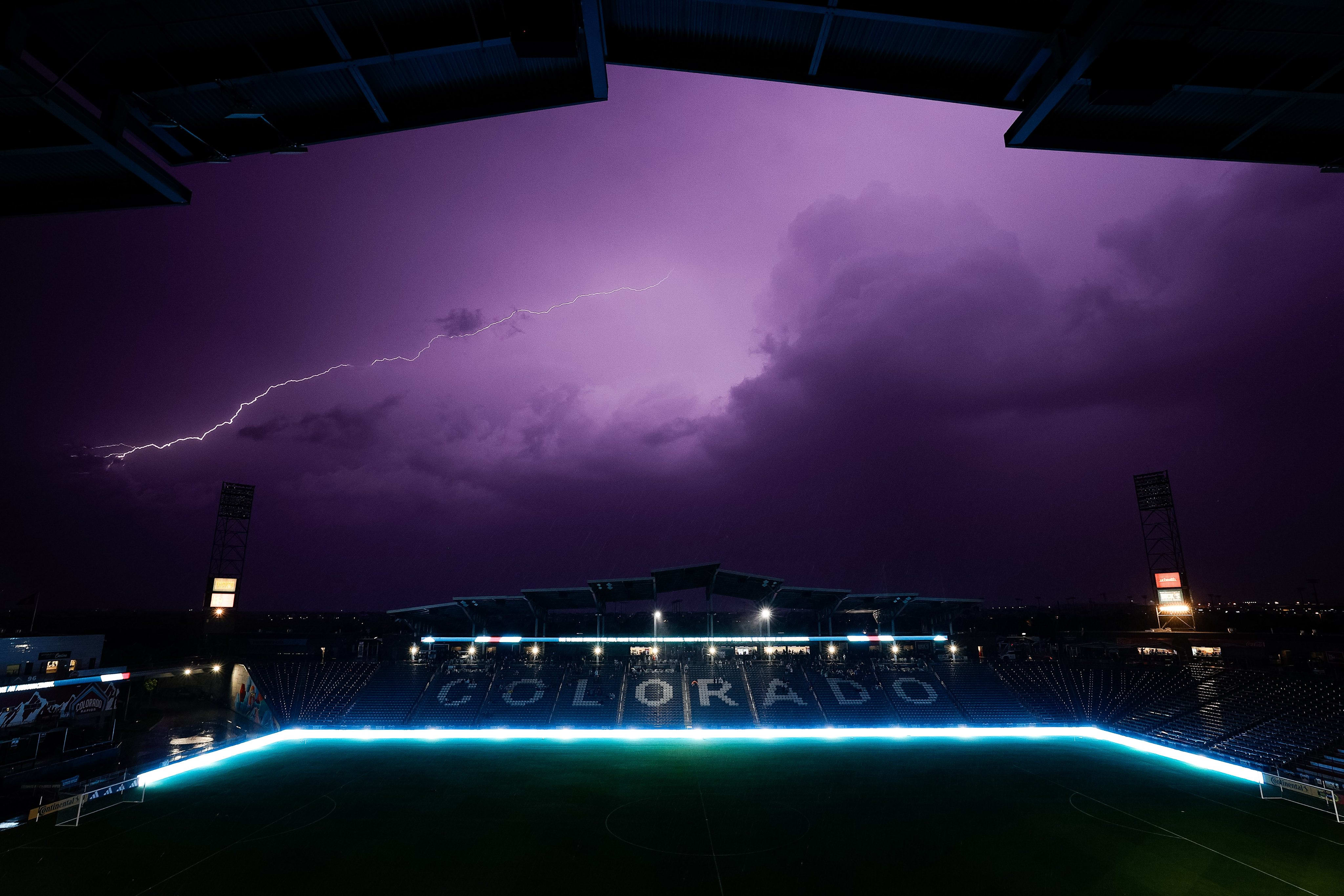
The MLS game between Colorado Rapids and Vancouver Whitecaps (pictured above) was postponed after a severe thunderstorm warning and tornadoes were reported nearby.
The National Games in Mexico (who will co-host the World Cup in 2026) struggled to cope with a heat wave, with matches suspended and athletes hospitalised.
The risk assessment for potential adverse weather conditions at World Cup 2026 was carried out in 2018. Overly high temperatures were assessed as 'low risk'. In light of these recent events, does the risk of extreme weather now need reviewing?
UEFA Respect Forum
The recording is available to watch for free online. It felt like a useful step forward in bringing a range of industry perspectives into the open and hearing different views on opportunities, challenges, and next steps.
Alongside new fan representation on UEFA committees, it potentially shows signs of a different approach emerging compared to how other leagues and international bodies are currently approaching climate issues. To cherry-pick some points that stood out for me:
The biggest unprompted applause came for footballer Morten Thorsby when he said the elephant in the room was the number of games being played and the number of tournaments being increased.
UEFA are developing a ‘Carbon Footprint Calculator’ for measuring, managing and disclosing emissions. It will be completed in August and finalised at some point soon after for clubs and leagues to draw on. Done right, this could be super-useful.
A number of points made by UN representative Lindita Xhaferi-Salihu were spot on. These included saying that there is a need for all in sports to move at pace with action and that there is no need to have fossil fuel sponsorship. (Separately last week, new CDP research showed “no oil and gas companies have plans in place to phase out fossil fuels”).
The trickiest question from the floor was about the location of the European club tournament finals and reducing the travel emissions they cause. The responses from the panel demonstrated that it’s not an easy issue but also did not set my mind at rest that no reform is possible. More innovative thinking is needed here.
For EURO 2024
a target has been set to reduce emissions by 20-25% from the 490,000 tCO2e estimated emissions made by the Öko-Institut.
Extensive planning has gone into ensuring teams can travel to matches by train, including ensuring security. Scheduling to minimise fan travel, and incentives to use public transport, has also been given a lot of consideration.
Rather than offsetting remaining emissions UEFA are, following an idea from the Öko-Institut, providing financial support to sports organisations to improve their sustainability.
Some comments …
In this newsletter, I’ve argued that football needs to have a collective stocktake to course correct and accelerate progress. It’s good that UEFA is already planning to hold this event again and are considering ways to build on it next time.
Suggestions:
Take forward and act quickly on tricky issues raised at the event including the number of matches and the locations of finals.
Next time, increase the participative element, dig into some big hard practical challenges, and broaden the scope of those invited further.
Other football authorities could learn from this approach, bring people together and look to go further.
Other notables
Bayern Munich and Qatar Airways agree to end sponsorship following a fan campaign on human rights. And elsewhere in sport Barclays sponsorship of Wimbledon came under the spotlight due to its approach to climate financing. Sponsorship departments in clubs will no doubt sit up and take notice of these developments. As Deloitte recently noted …
“Rights owners and sponsors are more cautious in entering into commercial agreements, seeking to reflect the increased expectations from fans around social responsibility”.
EU recommendations for a common framework for sustainable sport are due to be published in late summer 2023. EU presentation is available here.
The transfer window is open and a private jet was used to fly one man from Germany to England.
Fossil Free Football is crowdfunding to support its work and build on its success with the Swiss advertising authority ruling in regard to FIFA.
Around the world: Foram Initiatives engaged with the Benin Football Federation and others on net zero in football. The Ball - football’s equivalent to the Olympic Torch -arrived in Kiribati as part of awareness raising on climate change. The Irish Football Association launched a new sustainability strategy. LeParisien looked at the integration of sustainability criteria into the licensing system in France.
Facilities
LaLiga had an open invitation for ideas for making Spanish football clubs more sustainable and received over 40 entries. Eight of them recently got the opportunity to pitch their ideas.
Queen’s Park Rangers FC have unveiled a new state-of-the-art sustainable training ground.
Work is set to begin on a £1m carbon neutral Edinburgh football centre project.
Learn here how football clubs can team up with community energy to save money and carbon.
Kit
Forest Green Rovers and the Grateful Dead is a partnership I never expected to see, though maybe in retrospect I should of.
Liverpool, Hajduk Split and Inter Miami are among clubs announcing new kits made from recycled materials.
I’d be very interested to hear from anyone with knowledge about apparel and sustainability, and their insights on what’s happening and if/what more needs to happen.
Co-benefits
‘Enough is enough.’ Too much soccer aggravating MLS players and coaches. Less games would mean less travel for players and would be better for them and better for the planet.
Premier League plans for more Friday and Monday evening matches. Timings of games affect the transport options available and therefore fans’ ability to choose more environmentally friendly forms of transport. Making climate goals a core part of scheduling decisions would be better for fans and better for the environment.
Transparency and Accountability
Beyond sports, there were reports from key international organisations that will influence how clubs and authorities communicate and act on sustainability. Yep, they’re technical and detailed but very important and well worth getting your head around …
The inaugural global sustainability disclosure standards create a common language for climate-related information. This is incredibly useful stuff even if the “common language” is somewhat accounting-heavy. Hopefully, a more simplified version for lay readers will follow.
A new claims code of practice on corporate use of voluntary carbon markets provides a rulebook to follow for making credible climate claims. “Offsetting is on the way out” say Carbon Market Watch giving their view on it.
An excellent read on sustainability and transparency in tennis provides insights for football to consider too:
“Transparency is an essential pillar in ensuring that organisations remain accountable for the pledges they claim to be following. Within tennis, such transparency is lacking”.
An EU-funded Sport Transparency Index was launched. This sounds potentially exciting, though it’s early days and not clear yet what the indicators will be.
Last word
“ sport and its impact on the climate is a cause that does need more exposure and there are solutions available that aren’t hugely complicated or hard to implement”
Owen Slot, Chief Sports Writer, The Times in “Just Stop Oil: My guide to smarter protesting”
Phew! That was long. Too long? Any views are welcome. And if you have any ideas, suggestions, or points to make, either on the content or the structure, then just drop us a line.
And huge thanks again for your continuing support!
Fran James (he/him)
Football and Climate Change Newsletter
@fbandclimate footballandclimatechange@gmail.com