
Signing up is not delivering
Beyond the badges, to climate action that counts

A quick ask before we begin: if you get something from this, you can help keep it going by chipping in via Ko-fi. Always free either way.
Summary
This piece is prompted by the UN Sports for Climate Action Framework submitting a self-assessment to join a new UN Net-Zero Recognition Framework. It looks first at that self-assessment, then at the Recognition Framework itself, and what each means for football clubs and governing bodies.
It then turns to the corporate climate standards used across much of the rest of the economy but rarely in football. It looks at how they are developing, and why they, rather than the UN schemes, are where a club or governing body’s climate action is tested.
The analysis shows that signing up to the UN initiatives is worthwhile, and more clubs and governing bodies should do so. The low barrier to entry follows the framework's own stated principles: it is designed to be accessible, and it brings in organisations stricter standards would exclude. But that same low barrier means the badge signals intention rather than delivery. It demonstrates neither action nor a structured approach in line with recognised standards. Anybody reading “We have signed up to the UN Sports for Climate Action Framework” would be wrong to assume the club or body is making verifiable progress towards net zero.
Credible action means moving towards those corporate standards, cutting emissions, and pushing for the wider changes no club can make alone.
The UN Sports for Climate Action Framework
The UN Sports for Climate Action Framework (Sports for Climate Action) is a global initiative for sport, launched by the United Nations in 2018. It asks members to measure and reduce their emissions, and use the reach of sport to encourage wider climate action. Over 250 sports organisations have signed up, including 39 football clubs and governing bodies. Across sport, they range from the International Olympic Committee to much smaller federations and national committees. Football’s are mostly its largest clubs and bodies, such as Arsenal, Liverpool, FIFA and UEFA, though it also includes the likes of Forest Green Rovers and Oxford United.
In May 2026, Sports for Climate Action was one of eight initiatives that submitted a self-assessment to another part of the UN, applying to join a new “Net-Zero Recognition Framework”. Others included the Fashion Industry Charter for Climate Action and the Under2 Coalition, a coalition of regional governments. The 250-plus organisations signed up to Sports for Climate Action can also join individually until October 2026.
To apply, Sports for Climate Action assessed itself against the ten recommendations of the UN’s High-Level Expert Group on net-zero commitments. The result (here and here) is sport’s own account of its approach.
It rates itself “fully aligned” on just one recommendation: matching its lobbying and advocacy to its climate goals. On fossil fuels it rates itself “not aligned”, stating it has “no explicit fossil fuel phase-out or renewable targets”.
On the other eight recommendations, including transparency, transition planning and target-setting, Sports for Climate Action rates itself only “partially aligned”. It records that independent third-party verification of members’ emissions cuts “is not currently mandated”, and requires no published transition plan. Where the expert group looks for targets in 2025, 2030 and 2035, sport sets one for 2030 and a net-zero date of 2040, leaving a decade between its first target and last.
In submitting this self-assessment, Sports for Climate Action is not committing to close the gap between its approach and the expert group’s recommendations. It is setting out a snapshot of its approach, as required to join the Recognition Framework. Other initiatives ask for more.
The Sports for Climate Action initiative alongside others
Sports for Climate Action was one of eight very different initiatives that submitted a self-assessment to join the Recognition Framework. The others include a body representing the wine industry, a hub for small businesses, and a coalition of regional governments. Their variety is notable.
A 2026 review of the voluntary net-zero landscape by researchers at Oxford Net Zero called it a “competitive landscape” of overlapping schemes: converging on the goal of net zero, but diverging so widely on what reaching it requires that disclosure is inconsistent and organisations barely comparable.
These eight initiatives are a small instance of that wider pattern. Reading the other seven alongside Sports for Climate Action shows they cannot be scored against each other: they did not answer the same questionnaire in the same way.
Some initiatives graded themselves recommendation by recommendation; some answered against detailed sub-criteria; one replied in narrative prose. Their self-assessments cannot be lined up and compared, which is the first thing worth noticing.
Read side by side, the eight reveal how differently each has interpreted what “net zero” requires of its members.
Some initiatives require their members to undergo independent checking. The International Wineries for Climate Action requires members’ emissions inventories to be verified by an accredited third party to the ISO-14064 standard, and can downgrade or remove a winery that falls short. Planet Mark, a certification scheme, requires annual measurement and can withdraw certification from a member that stops meeting its requirements.
Others require less. The Under2 Coalition, whose members are regional and subnational governments, has “no mechanisms for the removal of non-compliant signatories.” The SME Climate Hub, built for small businesses with limited resources, asks for no third-party verification and is still deciding how to handle members that fall behind. Each has tailored its expectations to its members.
Sports for Climate Action is different. It asks for no independent verification; its own assessment says this “is not currently mandated”, and it names no standard its members must follow. But many of its members are neither small businesses nor public bodies. They include the wealthiest and most powerful organisations in world sport. The light-touch approach a small-business hub can reasonably justify is harder to account for in a body whose members often have the capacity to do far more.
Still, these eight share a minimal floor. To reach the Recognition Framework’s first level, a member needs a public pledge, “good standing”, and regular disclosure. What that means in practice is what this piece considers next.
The new net-zero recognition framework
The self-assessments were produced, submitted and published for a reason. Sports for Climate Action and others applied to join the Net-Zero Recognition Framework, a scheme the UN introduced at the COP30 summit in late 2025.
Joining it is a decision not only for these initiatives as a whole. Each of the 39 football clubs and governing bodies, and every other Sports for Climate Action signatory, now faces its own choice: whether to join individually. They have until October 2026 to decide. This makes it even more important to understand the Recognition Framework before signing up.
The Recognition Framework aims to showcase participants’ net-zero journeys. Each has five levels, from a public net-zero commitment at Level I to reaching net zero at Level V, with a transition plan, demonstrated progress and interim targets marking the stages between. The map below sets out those levels. The UN records which level an organisation has reached, and that record is the recognition: a public marker carrying the UN’s name of how far an organisation has come.
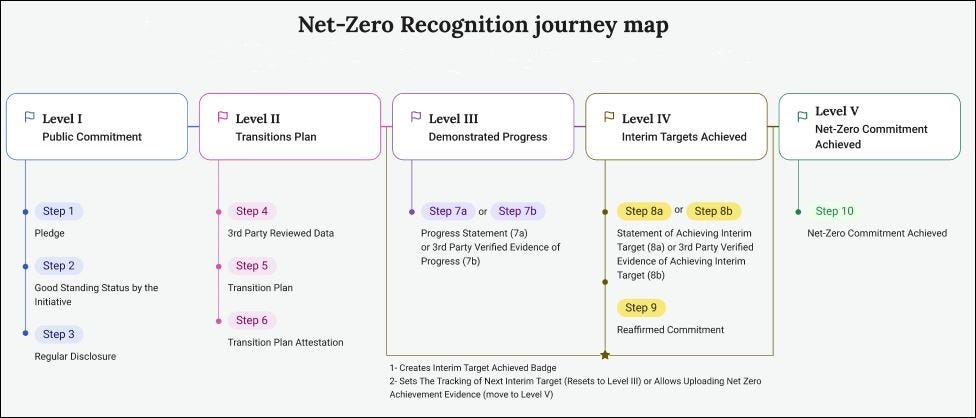
Two features of this journey deserve a closer look.
The first is direction of travel. The framework records only forward steps: no level marks whether an organisation has fallen behind, missed a target or stopped trying. So an organisation that joins, commits, then does very little stays where it is, still recognised, with nothing on the record showing the gap between promise and delivery1.
The second feature is how little the UN checks. It requires an outside check at a single point: to reach Level II, an organisation must provide “third-party reviewed data”. Every higher level is optional to verify. The framework never explains how “reviewed” differs from the stronger “verified” it offers, but does not require, higher up. Beyond that early step, an organisation can climb by saying it is making progress, with no outside confirmation.
Independent confirmation would count for most in one place in particular: proving that emissions reductions are on track and that targets and plans are being met. But here, the Recognition Framework makes it optional. Nothing in it requires that self-reporting be independently checked, or reported to a recognised standard.
This follows from how the framework came about. It grew out of an earlier UN proposal, the Net-Zero Recognition and Accountability Framework. Following consultation, it dropped the word “accountability”. The consultation’s co-chairs reported a “lack of unanimity amongst Parties” and a view that there were “quicker ways to accelerate the adoption of ambitious regulatory frameworks”2.
What has launched recognises what an organisation says about itself and leaves checking optional. It should not be mistaken for bringing order to the wider net-zero landscape. And as individual members begin joining in their own right, each bringing its own approach, the recognition badge risks making the picture harder to read.
The variety between initiatives reflects choices that can be revisited. The clubs and governing bodies in Sports for Climate Action are among those who could ask it to adopt the firmer expectations some other initiatives already set: to name a standard or require members’ reported cuts to be independently checked. What that approach should look like, and how far it should go, is not for this piece to settle. But the options are there. Members of Sports for Climate Action can press for change or accept the status quo. They cannot say they have no choice.
None of this means a club should stay out of Sports for Climate Action or the Recognition Framework. Signing up is a real, if small, first step. It is still more than most clubs have taken. But clubs and bodies should be clear, with themselves and others, about what a public commitment does and does not mean.
Making the commitment and reporting on it are the first moves in any journey to net zero, and the ones that prove the least. They show a club is willing to act. They do not show that anything is actually happening.
This raises the question any club or governing body serious about its emissions must answer next: if UN recognition does not show delivery is under way and emissions are falling, what would?
The role of corporate climate standards
This is where corporate climate standards come in: the internationally recognised rulebooks that companies across sectors increasingly follow to show their climate action stands up. They cover the core questions: how you count your emissions, what counts as a credible target and plan, and how you check whether emissions are actually falling.
Showing that a net-zero position is real rests on three things: measuring emissions properly; setting targets and a plan against a recognised external standard; and having an independent party check figures and progress against them. Measurement, targeting, verification. The standards ask for more than this, but without these three, none of it can be checked.
Football has done the first, measurement, in many cases. A number of clubs now count their emissions using the Greenhouse Gas Protocol, the same accounting framework used by companies across the economy. But only a handful of the biggest clubs and bodies break emissions down across the full range of categories the Protocol sets out. And the way clubs present figures and wider sustainability plans varies so widely that comparing one to another to assess progress is close to impossible. The foundation is being laid, unevenly and in formats that do not line up.
On the second, targeting, a small number of clubs and bodies across world football have set targets, including all those in Sports for Climate Action, but few beyond it. Those with targets are the exception, and almost none are validated against a recognised standard. And on the third, independent verification, the picture is murkiest of all. A few clubs and bodies publish emissions figures that appear to carry some external check, but the overwhelming majority do not. It is often unclear from what a club publishes whether its numbers have been checked at all.
The standards are closing the gap
The standards themselves are now closing that third gap from two directions. The most widely recognised standard for net-zero targets is set by the Science Based Targets initiative (SBTi), which checks a company’s targets against 1.5°C. Over 11,500 companies worldwide had validated targets at the start of 2026. Across world football, only a handful of clubs have joined them: Arsenal and Borussia Dortmund among them, though with different approaches - Arsenal sets an intensity target for its Scope 3 emissions, and BVB an absolute one3.
That validation examines a target’s design: its scope, baseline, timeframe and ambition. It does not look at the emissions data behind the target; that responsibility stays with the company. What the new version of the standard, published in June 2026, adds is a requirement that companies get that data checked. Larger companies must now obtain independent third-party assurance of their starting emissions, and again when they report progress at the end of each five-year target period. On the standard’s own size thresholds, every Premier League club, were it to apply, would count as one of those larger companies.
Alongside this development, a draft ISO standard for net-zero organisations is out for consultation until September 2026. It moves the same way on checking but differently on independence. It requires a net-zero claim to be checked at every stage, from first aspiration to reaching net zero. But it lets the organisation making the claim decide who checks it: an accredited outsider, a business partner, or itself. It acknowledges in its own words that “third party validation and verification reflects best practice and provides greater credibility.”
So the standards agree that net-zero claims must be checked. Both scale what they ask by the organisation's size. Every organisation still has to show it did what it said. They differ on who checks: SBTi requires independent assurance for larger companies, while ISO's consultation draft leaves the choice of checker to the organisation.
They also differ on what happens if a target is missed. The Recognition Framework takes the organisation's own statement of progress. SBTi allows it to continue only if it can show it "applied available levers within [its] control." Whether that is enough is contested. ISO goes furthest: an organisation must publish the size of its miss and loses the right to refer to the standard if it does not get back on track.
Taken together, the picture in football is one of uneven measurement, few targets or plans, and minimal validation or verification of emissions. It would not be fair to say football’s emissions are rising, or that they are on track for 2030 targets, because either claim would imply a clear public picture of where things stand. There isn’t one. And in 2026, while growing numbers of businesses in other sectors set climate targets, put plans in place, and sign up to rigorous standards, football has still not got its boots on.
Measurement and its limits
A club can sign up to Sports for Climate Action, and then to the Recognition Framework layered on top. Both are worth doing, and both are more than most clubs in a laggard sector have managed. But neither is delivery, and neither requires anyone to check that a club’s targets and plans are fit for purpose, or that its emissions are falling. The real work sits beyond joining. And, to be clear, a club or body could clear that floor without the UN at all, by going straight to a recognised standard like the Science Based Targets initiative.
Measuring is the only way a club learns what it can cut, and how much it can cut. Importantly, it also shows how much of its footprint the club can address on its own, and how much can only shift through collective action. Until football measures consistently, there is no clear picture of either.
Once a club measures to the standards, it will understand the scale of its challenge, and find that important parts of its footprint are not, in fact, its to fix alone. A stadium’s electricity can be cut through things such as efficient lighting and on-site solar, but how clean the rest is depends on how fast the national grid decarbonises. Recycled kits and longer kit cycles help, but most emissions in kit and merchandise sit in supply chains and the churn of frequent new releases, which a club shapes only in part.
The biggest source for most clubs, the travel of supporters, is partly football’s own to decide, partly within its influence, and partly beyond it. A club chooses whether to play a friendly locally or on the other side of the world; a governing body sets how many games a tournament runs and when they kick off. A club can influence how they travel, for instance through incentives for low-carbon transport. But how fans then reach the match also turns on the public transport that exists, the infrastructure for walking and cycling, and the pace of the shift to electric vehicles. Proper measurement produces not just a number but a plan, showing where a club’s own efforts are best placed, and where they run out and the problem passes beyond any single club.
Beyond the club
That plan should make clear why club action is necessary but not sufficient. What lies past the club’s own reach is not all of one kind. Some is measurable but belongs to others to fix. Some requires systemic change that is not easily reduced to numbers. A plan’s first use is for the club itself: it identifies a club’s own unique circumstances, and shows which emissions are the club’s to cut and how much can be saved. That work pays off for the club directly.
The same metrics have a second use. They become evidence for where policy has to change, and by how much. That second benefit comes about especially if football measures widely and then acts together. Whether a sport so marked by governance failures will do so is an open question. None of this is a reason to wait: a club can act on its own emissions now. But the wider case is best built on evidence that exists, and right now it barely does.
There is a further issue, touched on earlier, and it may matter more. Emissions measurement identifies and targets what an organisation can affect in and around its own operations. It says little about the wider influence a club or body can have, for good or ill, beyond them. This matters especially in football, given how much of the world’s attention the game commands. What football promotes, whose money it takes, and what it lobbies for shape what its audience treats as normal, and no emissions ledger records any of it. A growing body of work is trying to bring this influence into view more clearly, the very thing the counting frameworks were never built to capture4.
Clubs must do more, but that doesn’t let policy-makers off the hook. And “policy-makers” here means more than governments. Essential parts of football’s footprint turn on public decisions about the grid, transport and planning, and on the choices football’s own governing bodies make. So the pace of decarbonisation is set as much by policy as by any club’s work. Clubs produce the evidence and cut what is theirs to cut; the bodies that set the conditions decide how much further the sport can go.
The real test
So the real question a club serious about climate change should ask is not “have we joined the right things?” It is whether it can show what it is actually doing, and prove it. You would be hard-pressed to find a club or body in the world that can yet do so.
And for the rest of us, the supporters, campaigners and anyone who wants football to take this seriously, the response to a new badge should be to treat it as a welcome start, then ask what has actually changed. To return to the development that prompted this piece: a UN badge is worth having. It tells us almost nothing about whether anything is happening underneath it.
Three things, finally, sit outside everything above, each deserving a piece of its own. The first, as touched on above, is football’s wider influence. The second is the role of regulation in shaping football’s actions and how it relates to voluntary initiatives. The third is the one the whole focus on initiatives, frameworks and standards still ignores. All of that is about cutting emissions, football’s effect on the climate. It says nothing about the reverse: preparing the game for a climate that is already changing around it through adaptation and resilience work. That reckoning is needed, and football has barely begun it.
Endnote
The analysis is put together from primary sources, but experts and practitioners may read the same documents differently, or take a different view.
I actively welcome responses from practitioners, fans, and researchers who can identify errors, supply additional evidence, or offer alternative readings. The aim is a proper debate, rather than the last word.
The one apparent exception is the reset at Level IV. Meeting an interim target earns an “Interim Target Achieved Badge”, then either resets tracking to Level III for the next target or, if net zero is reached, allows a move to Level V. So the journey can move an organisation backwards, but only as part of succeeding, never as a mark of failing.
What these ‘quicker ways’ are considered to be was not made clear in the consultation report and recent analysis suggests that movement to ambitious frameworks is far from certain.
Three further SBTi-related points of note: 1) The other clubs listed on the SBTi Dashboard are Fukushima United FC and FC Osaka. 2) Arsenal’s Scope 3 intensity target is based on “per million GBP of value added”. Further work would be welcome to establish whether a turnover related target such as this is appropriate for football. 3) UEFA’s own new event guidance, published in June, tells organisers to “set science based targets consistent with Science Based Targets Initiative (SBTi) guidance,” though UEFA has no SBTi-validated target itself and no stated intention to seek validation .
For readers who want to follow this further, two pieces as starters, with plenty more available besides: Oxford Net Zero and Futerra’s Spheres of Influence (2025) and Höglund and Wigg’s Build the World Your Net Zero Target Assumes (2026) provide just two different perspectives in a lively, important and developing field of work.